
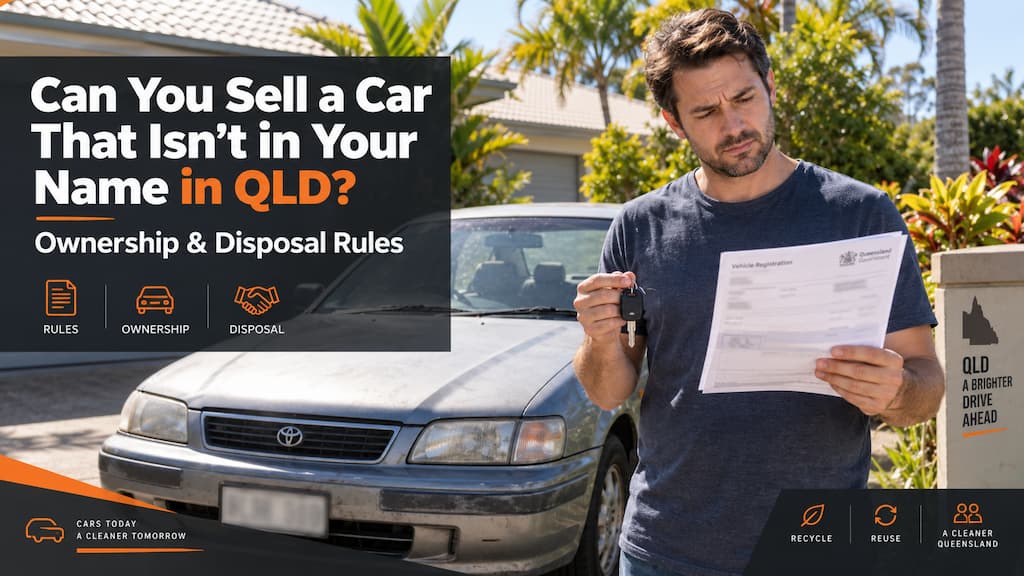
There’s a car sitting in your driveway. You’ve got the keys. You’ve probably been paying for it, insuring it, or at least mowing around it for the past two years. But when you pull out the registration paperwork, somebody else’s name is on it — an ex-partner, a parent who has passed away, a bloke you bought it from in 2019 who you’d struggle to find on Facebook now.
So the question is simple, even if the answer isn’t: are you actually allowed to sell it?
In Queensland, the answer comes down to a distinction most people have never had a reason to think about. And once you understand it, your own situation usually sorts itself out in about thirty seconds.
The Short Answer: It Depends on Whether You Own the Car or Just Have It
In Queensland, you can legally sell a car that isn’t registered in your name if you are the vehicle’s legal owner, or if you have written authority from the person who is. You cannot sell a car that simply happens to be in your possession — including one abandoned on your property — until you’ve either reached an agreement with the owner or obtained a court order allowing you to dispose of it.
That single sentence resolves most cases. The complication is that “owner” and “the name on the rego” are two different things in Queensland, and a lot of people assume they’re the same.
In Queensland, Registration Is Not Ownership

This is the part that trips everyone up, so it’s worth being precise about it.
What “Registered Operator” Actually Means on Your Rego Papers
Queensland doesn’t issue a certificate of title the way some overseas systems do. What the Department of Transport and Main Roads (TMR) records is a registered operator — the person or entity responsible for the vehicle on the road. That’s who fees are billed to, who infringement notices go to, and who TMR holds accountable for the vehicle’s roadworthiness.
Queensland Government says this plainly: a registration certificate does not prove ownership. It confirms who is recorded as responsible for the registration, and that is a different thing.
Who Counts as the Legal Owner of a Vehicle in QLD
Ownership is a property law question, not a transport department question. You own a vehicle because you bought it, inherited it, or were given it — and you prove that with things like a receipt, a bill of sale, bank transfer records, a will, or a court order.
There are really three separate questions here, and it helps to keep them apart:
- Who owns the vehicle? A property question.
- Who is recorded with TMR? A registration question.
- Who is authorised to act? A question about representation, which can be a third person entirely.
The answers often point to the same person. They don’t have to. Which means both of these are common:
- You are the legal owner but not the registered operator — you bought the car and never got around to the transfer
- You are the registered operator but not the owner — the car is in your name as a favour, or you sold it and the buyer never lodged the transfer
Why This Distinction Decides Everything About Your Sale
⚠️ If you own the car, you can sell it. The rego mismatch is a paperwork problem, not a legal barrier.
If you don’t own the car, no amount of possession changes that. Having the keys, having paid for repairs, or having stored it for three years does not make it yours.
Everything below is just working out which of those two you are.
Six Situations Where a Car Ends Up in Someone Else’s Name
You Bought the Car but Never Transferred the Rego
Verdict: you can sell it.
You’re the legal owner. The transfer simply never happened — usually because the car was cheap, the seller said “don’t worry about it,” and neither of you followed through.
‼️You’ll need to prove the purchase: the original receipt or bill of sale, a bank transfer, messages agreeing the sale, or the signed transfer paperwork the seller gave you at the time.
One thing to understand before you try to on-sell it. Queensland’s online transfer runs in two stages: the seller transfers the registration out of their name first, and only then can the buyer finalise it and pay the fees and duty. If that first stage never happened, the registration record still points back to the person who sold it to you. Resolve that before you introduce a third party into the chain, rather than after.
If you have no purchase evidence at all, you’re in a weaker position and may need to trace the previous registered operator or take the disposal route rather than a private sale.
The Car Is in a Parent’s, Partner’s or Ex-Partner’s Name
Verdict: you can sell it with their involvement — not without it.
If the registered operator is alive and contactable, this is the easiest fix in the whole article. They either sign the transfer paperwork themselves, or they give you written authority to act for them.
A verbal “yeah, do what you like with it” is not enough. If the relationship is strained — and with ex-partners it usually is — get it in writing before you spend a minute of your time on the sale.
The Registered Operator Has Died
Verdict: you can sell it, but only through the estate.
When TMR is notified of a death, it places a restriction on any vehicles registered to that person. The registration can’t be renewed until it’s transferred to a living person or entity, or cancelled. TMR generally writes to the deceased person’s last known address setting out which vehicles and plates need dealing with — keep that letter with the estate paperwork if it arrives.
The person who can act is the executor named in the will, or the administrator appointed where there’s no will. Where the vehicle was registered in two names, it can usually pass to the surviving registered operator on proof of death, without the same process.
There’s also a timing rule worth knowing: a beneficiary generally has to survive the deceased by 30 days to benefit under a will, so transfers into a beneficiary’s name shouldn’t be lodged during that window unless the will says otherwise or the vehicle is going into the estate’s name.
This is the one situation where it’s genuinely worth slowing down. Being the deceased person’s son, daughter or spouse is not by itself authority to dispose of their vehicle — entitlement to deal with the estate is. Sorting that first will save you far more grief than moving fast will save you time. The Queensland Government’s deceased estate registration page sets out the requirements in plain terms.
A Tenant, Flatmate or Ex Left the Car Behind
Verdict: you cannot sell it — yet.
This is the situation people get most wrong, and the one with the real legal risk. Owning the land a car sits on gives you no ownership of the car. It is somebody else’s property that happens to be on your property.
There is a process for dealing with it, covered further down in this article.
The Car Is Registered to a Business That No Longer Operates
Verdict: usually yes, with the right documentation.
A vehicle has to be registered to a person or a legal entity. If an organisation ceases to be a legal entity — company deregistration is the usual cause — the registration has to be transferred to another legal entity or cancelled. Someone with authority to act for the business has to do it: a former director, the person appointed to wind things up, or whoever the records establish as entitled. Queensland Government has a dedicated page on transferring registration from a non-legal entity.
⚠️Expect to produce evidence of your authority. TMR won’t take your word for it, and neither should a buyer.
There’s Still Finance Owing on the Vehicle
Verdict: not until the finance is settled.
If money is owed against the car, the financier has a security interest in it. Selling it without settling that debt causes problems for you and for whoever buys it, because the interest follows the vehicle.
Run a search on the Personal Property Securities Register before you do anything. A vehicle search costs about $2. You’ll need the VIN — a number plate or engine number won’t work.
When You Legally Cannot Sell the Car
Being direct about this is more useful than hedging. You cannot sell a vehicle in Queensland if:
- You have possession but no legal claim to it — an abandoned car on your property, until you have the owner’s agreement or a court order
- The vehicle is stolen, or you have reason to suspect it might be — if the story you were told doesn’t add up, stop and check
- There’s unsettled finance against it and the financier hasn’t been paid out or agreed to the sale
- The registered operator is deceased and the estate hasn’t been dealt with — you can’t sign as an executor you haven’t been appointed as
- You’d have to sign a transfer form as the registered operator when you aren’t one. Signing someone else’s name on a TMR form is not a paperwork shortcut. It’s a false declaration.
If you’re in one of these, the answer isn’t “find a buyer who won’t ask.” It’s to fix the underlying problem first — and the fix is usually less painful than people expect.

How to Prove You Have the Right to Sell in Queensland
Documents That Establish Ownership When the Rego Doesn’t
In rough order of how much weight they carry:
- A signed bill of sale or receipt naming you as the buyer, with the VIN and date
- Bank records showing payment to the previous owner
- The transfer paperwork the seller completed and handed you, even if it was never lodged
- A will, grant of probate, or letters of administration
- A court order
- Written authority from the current registered operator
Our guide on whether you need a bill of sale in QLD covers what a workable one should contain — worth reading before you write one from scratch.
Written Authority From the Registered Operator (TMR Form F5225)
This is the piece almost nobody knows about, and it’s the direct answer to “can I sign for them?”
TMR has a form — Authority to Represent Registered Operator (F5225) — that lets a registered operator authorise another person to sign and present vehicle registration forms on their behalf. The registered operator completes and signs it. You then present the original authority along with evidence of your identity and evidence of theirs. The authorisation can run for up to 12 months.
One important limit. F5225 is an authority to act in registration transactions. It does not make you the owner of the vehicle and it does not settle a dispute about who owns it. If two people genuinely disagree about whose car it is, that’s a separate argument and no TMR form resolves it. Use F5225 for what it’s for: getting the paperwork signed and lodged by someone other than the registered operator.
The form is listed on the Queensland Government publications portal, and other registration forms are on the TMR forms page.
For a full power of attorney arrangement, that document does the same job and more, but it needs to be properly executed — it’s not something to draft on a Sunday afternoon.
Executor and Administrator Paperwork for a Deceased Estate
If you’re acting for an estate, TMR has a dedicated application for transacting on behalf of a deceased person’s estate (form F5296). Depending on the estate, you may need:
- the death certificate or coroner’s report
- the grant of probate, or letters of administration
- the deceased person’s will
- evidence of your identity
Where probate or letters of administration have been granted, the originals or certified copies are presented with the F5296. Where there’s a valid will but no probate, the executor named in the will has their own requirements to complete. Where there’s no valid will, next-of-kin rules under the Succession Act can apply.
📌 There are some helpful exemptions in this scenario. A transfer to the beneficiary of a deceased estate is generally exempt from the safety certificate requirement, and duty exemptions may apply. Confirm what applies to your circumstances with TMR on 13 23 80 before you assume.
What a PPSR Check Does and Doesn’t Tell You
Run one. It costs about $2, takes two minutes, and it will tell you whether there’s a security interest recorded against the vehicle, and often whether it’s been recorded as written off or stolen. You search using the VIN, not the rego.
But it does not tell you who owns the car. The PPSR is not an ownership register and it carries no ownership history. A clean search means no recorded security interest — it does not mean the person standing in front of you is entitled to sell the vehicle. That’s a common and expensive misreading.
Keep the three checks separate in your head:
A registration problem is not an ownership problem is not a finance problem. Each one has to be answered on its own.
What to Do When You Can’t Contact the Registered Operator
This is the most common dead end, and there are three realistic paths.
1️⃣First, TMR can release registration information in defined circumstances through a Release of Information Request (form F3522), though the registered operator’s consent is generally required and they’ll be contacted to confirm it. The release of information page explains who can apply without consent.
2️⃣Second, if you can demonstrate you’re the legal owner through your purchase documents, the missing operator becomes less of an obstacle than it feels.
3️⃣Third — and this is where most people in this position land — if the car is unregistered, not running, or simply not worth the effort of chasing a stranger from six years ago, the practical answer is disposal rather than a private sale.
Selling vs Disposing: What Changes When the Car Is Scrap
Here’s where a lot of readers realise their problem is smaller than they thought.
Safety Certificate Rules and the Exemptions That Apply
Two things worth separating, because Queensland changed one of them.
You no longer need a safety certificate simply to advertise or offer a registered vehicle for sale. That requirement is gone.
You generally do still need one before disposing of a registered vehicle — other than to a dealer — unless an exemption applies. The certificate is issued by an approved inspection station, is valid for two months or 2,000km (whichever comes first), and covers one transfer only. The prescribed inspection fee for a light vehicle up to 4,500kg GVM is $102.70 at the time of writing; check the current figure before you budget on it.
The exemptions matter enormously to this cohort of sellers. A safety certificate is generally not required if:
- The vehicle is unregistered
- You’re selling or trading it to a licensed motor dealer
- The transfer is to the beneficiary of a deceased estate
- Certain other prescribed transfers apply, including some between spouses
Read that again if you’ve been dreading an inspection. Most cars that end up stranded in someone else’s name are old, unregistered, or wouldn’t pass without money you’d never get back. The exemptions exist for exactly this situation. Our safety certificate guide for Queensland goes through the detail. If you’re not sure whether your transaction qualifies, confirm it with TMR rather than assuming.
Unregistered Cars and the Transfer That Never Happens
If the vehicle is already unregistered, there’s no registration to move into anyone’s name. Ownership passes with a signed receipt or bill of sale, and the buyer deals with registering it later if they intend to put it back on the road.
That’s a simpler transaction, but not a documentation-free one. Queensland expects a paper trail for the sale of an unregistered vehicle, and it should include:
- both parties’ signatures
- the VIN, and the chassis and/or engine number
- the make and model
- the date of sale
A basic contract or transaction receipt is fine as long as it captures all of that. Both of you keep a copy.
The other catch is movement. An unregistered vehicle generally can’t be driven on Queensland roads without an unregistered vehicle permit and appropriate CTP cover, and if it isn’t safe to drive, it has to go on a tow truck. For an old or non-running car, that single fact often changes the economics of the whole sale. See our guide on selling a car without rego in QLD for the full picture.
Written-Off, Flood-Damaged and Statutory Write-Off Vehicles
Write-off status has to be disclosed, and it will show up on a PPSR search anyway.
A repairable write-off can be repaired, inspected and re-registered. A statutory write-off cannot legally return to the road in Queensland at all — which means it’s a parts or scrap sale, full stop. South East Queensland has a meaningful number of flood-damaged vehicles still sitting in previous operators’ names for exactly this reason.
If that’s your car, the ownership question and the disposal question have collapsed into the same question. Nobody is buying it to drive.
A Car Has Been Abandoned on My Property — What Are My Rights?
The answer splits depending on where the car actually is.
If the Car Is on a Road, Footpath or Park in Brisbane
This one isn’t yours to solve. Brisbane City Council runs an unmanaged vehicle process covering vehicles on roads, footpaths, road-related areas and parks that are abandoned, unregistered, hazardous or dilapidated. Council can investigate, attempt to contact the last known registered owner, and arrange removal where appropriate.
Report it and let them handle it. Other South East Queensland councils run equivalent processes for vehicles in public areas.

If the Car Is Inside Your Property, You Can’t Just Sell It
Because it isn’t yours. When someone leaves their property with you, the law treats it as bailment: you’re expected to take reasonable care of it, and you don’t get to dispose of it because it’s inconvenient. Legal Aid Queensland is blunt about the consequences — get rid of someone’s belongings without their agreement and you can be liable to the owner for their value, or charged with theft.
This applies whether the car was left by a departing tenant, an ex-partner, a flatmate who moved out, a former employee on business premises, or someone you’ve never met. It applies if the car has no plates, no keys and four flat tyres. Derelict isn’t the same as ownerless. And if you don’t know whether the vehicle carries finance or has been reported stolen, that’s another reason not to move quickly.
Written Notice, Agreement, or a Court Order
Here’s the part most people get wrong. If the owner refuses to collect the vehicle, you remain legally responsible for it until you either reach an agreement with them or get a court order allowing you to dispose of it. Sending a letter and waiting a few months does not, by itself, make the car yours to sell.
What the notice does is set you up to apply. The realistic sequence:
- Try to contact the owner in writing, and keep copies. A registered letter to the address recorded with TMR is the standard approach.
- Give written notice requiring collection by a stated date, and stating that you intend to apply to the court for a disposal order if they don’t.
- If they still don’t collect, that notice is what supports your application to the court — it isn’t what authorises the sale.
- Dispose of the vehicle once you have either the owner’s written agreement or the order.
The Disposal of Uncollected Goods Act 1967 sits behind this area, and different rules apply to different situations — a trader holding a car after repairs is treated differently from a homeowner with an ex-partner’s car in the carport. If the car was left behind by a tenant, residential tenancy rules apply instead and the Residential Tenancies Authority has specific guidance on goods left behind. If it’s on body corporate common property — a real issue in inner-Brisbane unit blocks where an abandoned car occupies a numbered space — the by-laws and committee process come into it before anything else does.
Legal Aid Queensland’s abandoned goods page is the right free starting point, and for anything contested, get proper advice. This is one area where an hour with a solicitor is cheaper than getting it wrong.
When to Involve the Police
Notify police if you have any reason to think the vehicle may be stolen, or if the situation involves a dispute that could escalate. Police can’t force someone to collect their car, and they generally won’t resolve a civil ownership question for you — but they will tell you quickly if the vehicle is flagged.
Once you’re properly clear to dispose of it, you still have a car that can’t be driven. That’s the easy part — a licensed operator will collect it. If you’re in the southern corridor, cash for cars Logan covers Meadowbrook, Springwood, Beenleigh and the surrounding suburbs where these cars tend to sit longest.
Your Paperwork Checklist Before the Car Leaves the Driveway
- Photo ID — a current Australian driver licence is simplest
- The registration certificate, or the vehicle’s reference number if you don’t have the paper
- Your proof of ownership: bill of sale, receipt, bank records, or estate documents
- Written authority (F5225) if you’re acting for a living registered operator
- A PPSR search result
- A signed bill of sale for this sale, with the VIN, odometer reading, date, sale price, both parties’ details and both signatures — two copies, one each
Then, after the car goes:
- Complete your side of the transfer, or notify TMR of the disposal, promptly. Queensland works to a 14-day window around transfers, and leaving it undone is how people end up with someone else’s tolls and infringements. Our guide on how the Notice of Disposal works in QLD explains exactly how sellers get caught out.
- Cancel your CTP and comprehensive insurance
- Remove personalised plates, and surrender plates to TMR if you’re cancelling the registration rather than transferring it
- Claim any registration refund you’re entitled to
- Keep your signed copies. All of them. For years.
There’s a fuller version in our QLD car selling paperwork checklist.

What a Licensed Queensland Buyer Will Ask You For — and Why
If a buyer asks for photo ID and proof that you’re entitled to sell, that’s not them being difficult. Second-hand dealers in Queensland operate under the Second-hand Dealers and Pawnbrokers Act 2003, which requires them to keep a transactions register and to ask for information about who they’re buying from. Motor dealers have their own obligations under the Motor Dealers and Chattel Auctioneers Act 2014.
In other words: the paper trail is the point. It protects the actual owner of every vehicle in Queensland, and it protects you, because there’s now a dated record showing exactly when the car stopped being your problem.
Expect to be asked for:
- Government-issued photo ID
- The registration certificate or vehicle details
- Proof of ownership or written authority
- Your signature on a purchase record
You can check any Queensland buyer’s licence yourself through the Office of Fair Trading’s public register. It takes a minute and it’s free. Junk Car Removals is a licensed and insured Queensland buyer, and any operator worth dealing with will be happy to be checked.
If a buyer doesn’t ask for ID, that should worry you more than one who does.
Your Disposal Options Compared: Private Sale, Dealer, or Car Removal
| Private sale | Licensed dealer / trade-in | Car removal / wrecker | |
|---|---|---|---|
| Safety certificate needed? | Yes, if registered | No | No |
| Who moves the car? | Buyer, and they’ll walk if it can’t be driven | You, usually | They do — free towing |
| Typical timeframe | Weeks | Days | Same day to 48 hours |
| Paperwork burden | All yours | Shared | Handled for you |
| Likely price | Highest — if the car is sound and the rego is clean | Moderate | Based on parts, scrap weight and demand |
Be honest with yourself about which column you’re in. If the car runs, has current rego, and the registered operator will sign — sell it privately. You’ll get more money and this article has already told you how to do it legally. Don’t call a wrecker for a good car.
Compare What You Keep, Not the Advertised Price
Where it gets less obvious is the old family car, the deceased estate vehicle, or the one that hasn’t turned over since 2022.
Say it might fetch $4,000 privately once it’s sorted. Getting there looks like:
- $1,400 mechanical work
- $400 tyres
- $102.70 safety inspection
- towing to and from the workshop
- advertising
- three or four weekends of no-shows and lowball offers
So the real comparison isn’t $4,000 private sale against a $2,500 as-is offer. It’s what you actually keep at the end, and how much of your time and risk each route consumes. Sometimes the private sale still wins. Often it doesn’t, and people only work that out after they’ve spent the $1,400.
If your authority to sell is sorted and the car is old, damaged, unregistered or non-running, getting an as-is figure gives you a second number to compare before you spend anything. For most people in Brisbane and the surrounding suburbs, a quote for cash for cars Brisbane takes less time than booking the safety inspection would.
The order matters, though: authority first, quote second. A buyer worth dealing with wants the paperwork right as much as you do.

Mistakes That Cost Queensland Sellers Money
- Spending money repairing a car you don’t have clear title to. Establish your right to sell it first. The repair bill is unrecoverable if you can’t.
- Treating a clean PPSR search as proof of ownership. It isn’t, and it never was.
- Assuming a waiting period lets you sell an abandoned car. Without the owner’s agreement, you need a court order.
- Accepting “I’ll transfer it later.” They won’t, and the infringements will find you.
- Handing over the plates with the car. Plates belong to the registration, not the vehicle.
- Treating a verbal OK as authority. Get it in writing, even from family. Especially from family.
- Letting the rego lapse mid-process without understanding what it does to your refund entitlement.
- Assuming you need probate for everything. Sometimes you do. Sometimes there’s a simpler pathway. Ask TMR before you assume the worst.
- Selling to whoever offers cash and asks no questions. That’s the one transaction most likely to come back to you.
Frequently Asked Questions
Can I Sell My Mum or Dad’s Car in QLD?
If they’re alive and they’ve authorised you, yes. Where you’re also handling the TMR side, an Authority to Represent Registered Operator (F5225) is the proper instrument. If the parent has died, different rules apply — see below.
Can I Sell My Deceased Parent’s Car Before Probate in QLD?
Sometimes. It depends on the estate and whether a grant of probate is required at all. Where there’s a valid will and no probate, TMR may accept the executor’s application with a statutory declaration. Where probate has been applied for but not yet granted, you generally can’t finalise anything until it comes through. Being the deceased’s child is not itself authority. Contact TMR on 13 23 80 with your specific circumstances.
Is a Signed Letter From the Owner Enough to Sell a Car?
For an informal private sale, a signed letter plus a copy of the owner’s ID is the bare minimum a cautious buyer will accept. For anything involving TMR paperwork, use the F5225 instead — it’s designed for exactly this and it won’t be knocked back.
Will a Car Removal Company Take a Car That Isn’t in My Name?
With the right documentation, yes — proof you’re the legal owner, or written authority from the registered operator, plus photo ID. Without any documentation, no reputable licensed buyer will touch it, and one who offers to is the last person you should be dealing with.
What Happens If the Registered Operator Lives Interstate or Overseas?
Distance isn’t a barrier. They can complete and sign the authority form and post the original to you. What they can’t do is give you permission by text message and consider the matter handled — identity evidence and original signatures still have to be dealt with.
Does a Bill of Sale Prove Ownership in Queensland?
It’s the strongest single document most private sellers will have. A good one names both parties, the VIN, the odometer reading, the date, the price and the condition, and is signed by both. It’s not a government-issued title, but combined with payment records it establishes ownership well.
Does a Registration Certificate Prove I Own the Car?
No. Queensland Government states expressly that it doesn’t. It records who’s responsible for the registration, not who owns the vehicle.
Can I Scrap a Car That Doesn’t Belong to Me?
Not on the basis that it’s old, broken or in your way. Establish who owns it and whether you’re entitled to dispose of it first. Where the car was simply left on your property, that means the owner’s agreement or a court order — not just the passage of time.
Who Pays the Fines If the Rego Was Never Transferred?
Whoever TMR has recorded as the registered operator, until the records say otherwise. This is why the disposal notification matters so much, and why “we’ll sort it out later” is the most expensive sentence in a private car sale.
Getting an Unwanted Car Gone Legally in Brisbane and South East Queensland
Work through it in this order and you won’t go wrong.
If you own the car and simply aren’t on the rego, you can sell it — get your proof of purchase together and go. If the registered operator is alive and reachable, get their signature or an F5225 authority before you do anything else. If they’ve died, deal with the estate first; it’s slower, but it’s the only path that holds up. If the car was left on your property, you need the owner’s agreement or a court order, and no amount of waiting substitutes for either. If it’s dumped on a public road or in a park, that’s a call to your council, not a sale.
And if what you’re left with is an old, unregistered, non-running or written-off vehicle that isn’t worth the inspection, the advertising and the tyre-kickers — that’s a disposal, not a sale. Selling to a licensed buyer removes the safety certificate requirement, the paperwork gets handled, and the tow is free, which matters when the car legally can’t be driven off your property anyway.
Junk Car Removals has been buying vehicles across Brisbane, Logan, Ipswich, Caboolture and the Gold Coast for over a decade, in any condition, with free removal and no charge for the paperwork. If you’re not sure whether your situation qualifies, ring 0483 333 444 and describe it — the answer takes about a minute either way.
Just get the authority right before you get the car gone.
This article is general information about Queensland vehicle ownership and disposal rules, not legal advice. Ownership disputes, deceased estates and vehicles left behind by another person can turn on circumstances that need individual advice. Forms, fees and requirements are set by the Queensland Government and change from time to time. Confirm your own circumstances with the Department of Transport and Main Roads on 13 23 80, or seek legal advice where ownership is genuinely in dispute.